

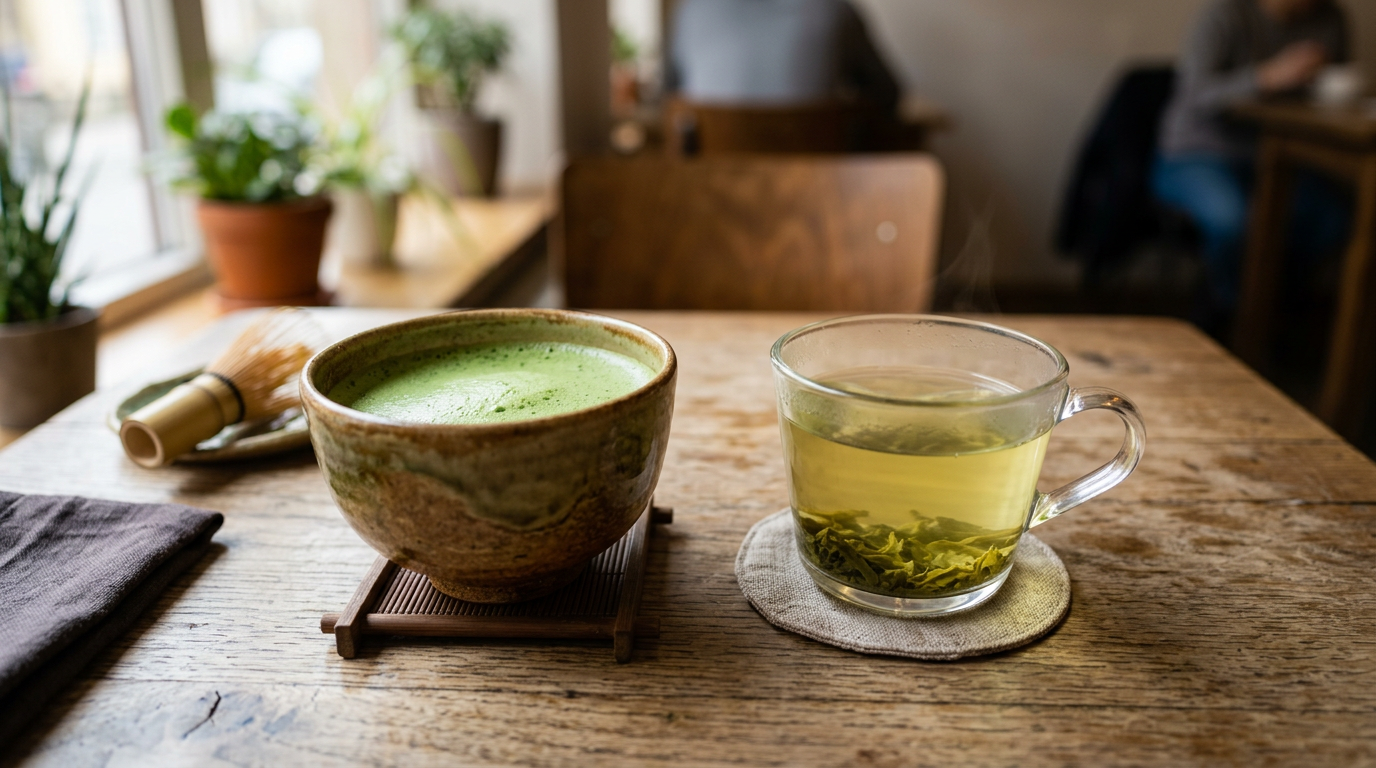
Matcha has gone from a Japanese tea ceremony speciality to a high-street latte in just a few years, and it’s easy to assume it’s simply a trendier name for green tea. In fact, they come from the same plant but are grown, made and drunk in quite different ways, and that changes the taste, the caffeine and the price.
This guide explains the differences in plain terms, so you can decide which suits you, or whether there’s room in the cupboard for both.
Same plant, different journey
Both matcha and green tea come from Camellia sinensis, the same plant that gives us black, white and oolong tea. What makes a tea “green” is that the leaves are heated soon after picking, by steaming or pan-firing, which stops them oxidising and keeps their fresh colour and flavour.
- Green tea leaves are grown in full sun, picked, heated, rolled and dried. You steep the leaves in hot water, then remove them, so you drink an infusion of the leaf.
- Matcha comes from tea bushes that are shaded for around three to four weeks before harvest. The shading makes the leaves produce more chlorophyll and more of an amino acid called L-theanine, giving a deeper green colour and a richer, sweeter taste. The leaves are steamed and dried, the stems and veins are removed, and what’s left is slowly stone-ground into a fine powder. You whisk that powder into water and drink it, so you consume the whole leaf.
That last point is the key to almost every other difference between them.
At a glance
| Matcha | Green tea | |
|---|---|---|
| Form | Fine powder, whisked into water or milk | Loose leaves or tea bags, steeped and removed |
| Growing | Shaded for 3–4 weeks before harvest | Usually grown in full sun |
| Taste | Rich, creamy, savoury (umami), slightly sweet | Lighter and fresher: grassy, vegetal or nutty |
| Colour | Vivid, opaque green | Clear pale yellow to light green |
| Caffeine (typical cup) | Around 60–70mg | Around 30–50mg |
| L-theanine | Higher | Lower |
| Antioxidants per cup | Higher, because you drink the whole leaf | Lower, but still a good source |
| Equipment | Bowl, bamboo whisk and a sieve, or a frother | A mug and infuser, or a teapot |
| Typical cost per cup | Higher | Lower, especially tea bags |
Taste
Matcha is bold and velvety. Good matcha tastes rich and savoury with a gentle natural sweetness and a smooth, creamy texture from the whisked foam. Lower grades can taste more bitter, which is why they’re usually mixed with milk or used in baking.
Green tea is lighter and more varied. Japanese green teas such as sencha are fresh, grassy and slightly marine, while Chinese green teas such as Dragon Well are often softer, with toasty or nutty notes. Brewed too hot or too long, any green tea can turn bitter.
Caffeine and that “calm focus”
Because you drink the whole leaf, a cup of matcha usually contains more caffeine than a cup of green tea. A typical serving made with about 2g of powder has around 60–70mg, compared with roughly 30–50mg for a cup of green tea. For comparison, an average mug of instant coffee has around 60–100mg.
Both teas also contain L-theanine, an amino acid that has been linked in studies with a relaxed, alert state of mind. Matcha has more of it, thanks to the shading. Many people find this gives a steadier lift than coffee, without the jittery peak, although everyone reacts to caffeine differently.
Health: what’s real and what’s hype
Green tea is rich in antioxidants called catechins, the best known being EGCG. Large observational studies of regular green tea drinkers have linked it with better heart health, although this kind of research can’t prove that the tea itself is the cause.
Because matcha is the whole ground leaf, you get more of these compounds per cup than from a steeped green tea. You’ll often see claims that matcha has “137 times” the antioxidants of green tea. That figure comes from a comparison with one particular, fairly weak green tea, so treat it with caution. Several times more per cup is a fairer estimate, depending on the teas being compared.
The honest summary: both are a healthy, low-calorie drink when taken without sugar, and matcha packs more into each cup. Neither is a miracle cure.
Worth knowing:
- Since you eat the whole leaf with matcha, quality matters. Buy from a reputable brand that states where its tea comes from, ideally Japan.
- The NHS advises pregnant women to keep caffeine below 200mg a day, which is about three cups of matcha or four to six cups of green tea.
- High-dose green tea extract supplements have been linked to liver problems in rare cases. This doesn’t apply to drinking normal amounts of tea, but it’s one more reason to enjoy it as a drink rather than a pill.
- Tea can reduce how much iron your body absorbs from food. If that’s a concern, drink it between meals rather than with them.
Matcha grades explained
Matcha is sold in grades, and the names aren’t regulated, so it helps to know what to look for.
- Ceremonial grade is made from the youngest, most tender leaves. It’s bright green, smooth and sweet, and is meant to be whisked with water and drunk on its own.
- Premium or daily grade sits in the middle. It’s good whisked with water or in a latte.
- Culinary grade comes from later harvests. It’s stronger and more bitter, which holds up well in lattes, smoothies and baking, and it costs much less.
Whatever the grade, look for a vivid green colour. Dull, yellowish or brownish matcha is old or low quality and will taste flat and bitter.
How to make them
The biggest mistake with both teas is using boiling water, which scorches the leaves and makes them bitter. Both prefer water at around 70–80°C. See our Brewing Temperature Guide for more, or let the kettle stand for a few minutes after it boils. A temperature-controlled kettle takes the guesswork out of it.
Matcha
- Sift 1–2g of matcha (about ½–1 teaspoon) into a wide bowl. Sifting stops lumps forming.
- Add a splash of water at around 75–80°C and mix into a smooth paste.
- Add about 70–80ml more water.
- Whisk briskly in a zig-zag “W” or “M” motion for 15–20 seconds until a fine froth forms. A bamboo whisk (chasen) works best, but a handheld milk frother does a good job too.
- Drink straight away, before the powder settles. For a latte, top up with warm or cold milk.
Green tea
- Use one tea bag, or about one teaspoon (2–3g) of loose leaves, per mug.
- Pour over water at around 70–80°C.
- Steep for two to three minutes, then remove the leaves or bag. Good loose-leaf green tea can be re-steeped two or three times.
Cost and keeping it fresh
Matcha costs more, both per tin and per cup, and ceremonial grade most of all. Green tea bags cost just a few pence a cup, and even good loose-leaf green tea is usually cheaper per cup than matcha.
Matcha also goes stale faster. Once opened, keep the tin tightly sealed in the fridge, away from strong smells, and try to use it within a month or two. Green tea keeps for several months in an airtight container in a cool, dark cupboard.
So which should you choose?
- Choose matcha if you want a richer, creamier drink, enjoy lattes, want a stronger caffeine lift than green tea without reaching for coffee, or like the ritual of whisking a bowl.
- Choose green tea if you want something light and refreshing to sip through the day, prefer less caffeine, or want an easy, inexpensive everyday cup.
- Try both if you can: plenty of people drink green tea through the day and save matcha for a morning or mid-afternoon treat.
New to matcha? Start with a culinary or daily grade in a latte. It’s more forgiving and much cheaper, and if you enjoy it, you can move on to a ceremonial grade to drink on its own.
You might also like

Leave a Reply